When you look at the Dubai skyline, what truly captivates you?
It’s the defiant gleam of glass against the desert sun. It’s the intricate geometry of aluminum that shapes the skyline.
It’s the architectural ambition that turns a sketch into an icon.
This is the power of facade construction.
Here in the UAE, a building’s facade is not just its face; it’s the hardest-working part of the entire structure.
It’s a high-performance engine that shields occupants from one of the world’s most demanding climates, a critical fire barrier, and the single biggest factor in your building’s long-term energy costs.
As a multi-disciplinary facade solutions contractor that has engineered, manufactured, and installed complex aluminum facade systems across the UAE, we at Leskor live and breathe this challenge.
We’ve seen firsthand how the right building envelope can make a project a landmark, while a poorly engineered one can lead to spiraling operational costs and compliance nightmares.
This isn’t just about cladding. This is about advanced engineering, precision manufacturing, and navigating a regulatory landscape that is one of the strictest on earth.
This is our complete guide for developers, architects, and stakeholders on what it truly takes to get facade construction right in the UAE.
The Aluminum & Glass Boom: The UAE Facade Market in 2025
The demand for sophisticated façade systems in the UAE is not just growing; it’s evolving. The market is projected to surge from USD 4.10 billion in 2025 to USD 5.6 billion by 2030, according to a 2025 market analysis by Mordor Intelligence.
But the real story isn’t just the number. It’s the why. What’s driving this growth?
- Giga-Project Demand: Visionary projects under the Dubai 2040 Urban Master Plan and Abu Dhabi’s ongoing expansion are pushing the boundaries of architectural design, demanding façades that are more complex, bespoke, and gravity-defying than ever before.
- The Flight to Quality: The “build it fast” mentality of the past is being replaced by a “build it smart” mandate. Clients and consultants now demand systems that offer proven, quantifiable performance, longevity, and sustainability. This is where expert facade engineering comes in.
- A Focus on Speed and Precision: In a market where timelines are everything, the shift towards unitized curtain walls is accelerating. This method, which involves fabricating entire façade panels in a factory, enhances quality control and dramatically shortens installation time.
At Leskor, we see this trend daily. Our clients are no longer asking for just an aluminum frame; they are asking for integrated facade systems.
They need holistic solutions that flawlessly combine high-performance glass, complex mullions and panels, and robust thermal breaks to deliver a complete, high-performance building envelope.
The Twin Dragons: Conquering UAE’s Heat and Fire
In the UAE, your façade is in a constant battle with two primary elements: relentless sun and the risk of fire. Your choice of façade construction methodology is your primary defense.
1. The War on Thermal Transfer (aka Your DEWA Bill)
The number one operational cost for any UAE building is air conditioning. The primary culprit? Solar heat gain.
Your façade is the only thing standing between the 50°C summer heat and a cool, comfortable interior. This is where the science of facade engineering becomes critical. We obsess over two key metrics:
- U-value (Thermal Transmittance): This measures how well the entire system (aluminum and glass) stops heat from passing through. A lower U-value is essential. This isn’t just about the glass; the design of the aluminum facade frame with effective thermal breaks is just as important.
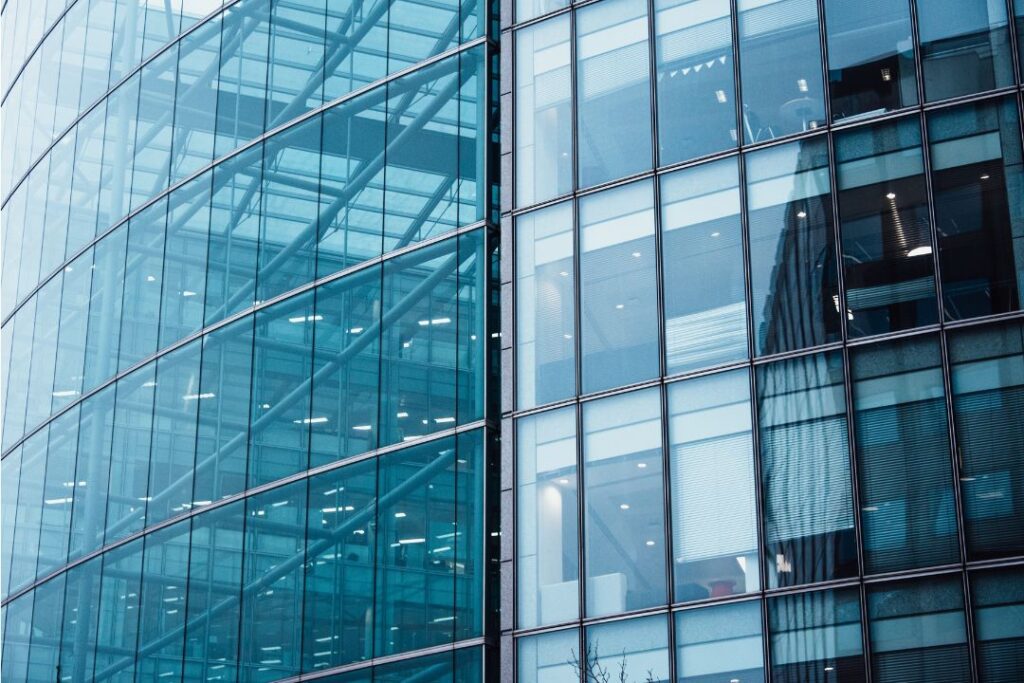
- SHGC (Solar Heat Gain Coefficient): This measures how much of the sun’s direct heat radiation gets through the glass. In the UAE, we specify glass with sophisticated Low-E (low-emissivity) coatings to reflect this heat, keeping the building cool without making the interior dark.
Specifying the wrong system can lock in astronomical DEWA bills for the building’s entire 30-year lifespan. A cheap façade is one of the most expensive mistakes a developer can make.
2. The Uncompromising Mandate for Fire Safety
The UAE, led by the Dubai Civil Defence (DCD), has implemented one of the world’s most rigorous fire safety codes. The UAE Fire and Life Safety Code of Practice is the bible for all facade construction and design.
Authoritative Source: The official UAE Government portal (u.ae) clarifies that these unified codes are mandatory. After several high-profile fires globally, the rules became crystal clear: combustible materials have no place on the facades of new high-rise buildings.
This has profoundly impacted facade design and material specification. It means that all components, from the aluminum composite panels (ACPs) and insulation to the gaskets and sealants, must be non-combustible or demonstrably fire-retardant (A2-rated) and part of a complete, DCD-approved system.
At Leskor, we built our reputation on integrity. For us, compliance is not a checkbox; it’s the foundation of our engineering philosophy. There is zero room for error.
An Engineer’s Perspective: The Battle of Unitized vs. Stick Systems
As specialists, we’re often asked: “Which is better, a unitized or a stick-built facade?”
The answer depends entirely on the project. Think of it as the difference between precision off-site manufacturing and skilled on-site artisanal work.
Stick-Built Systems
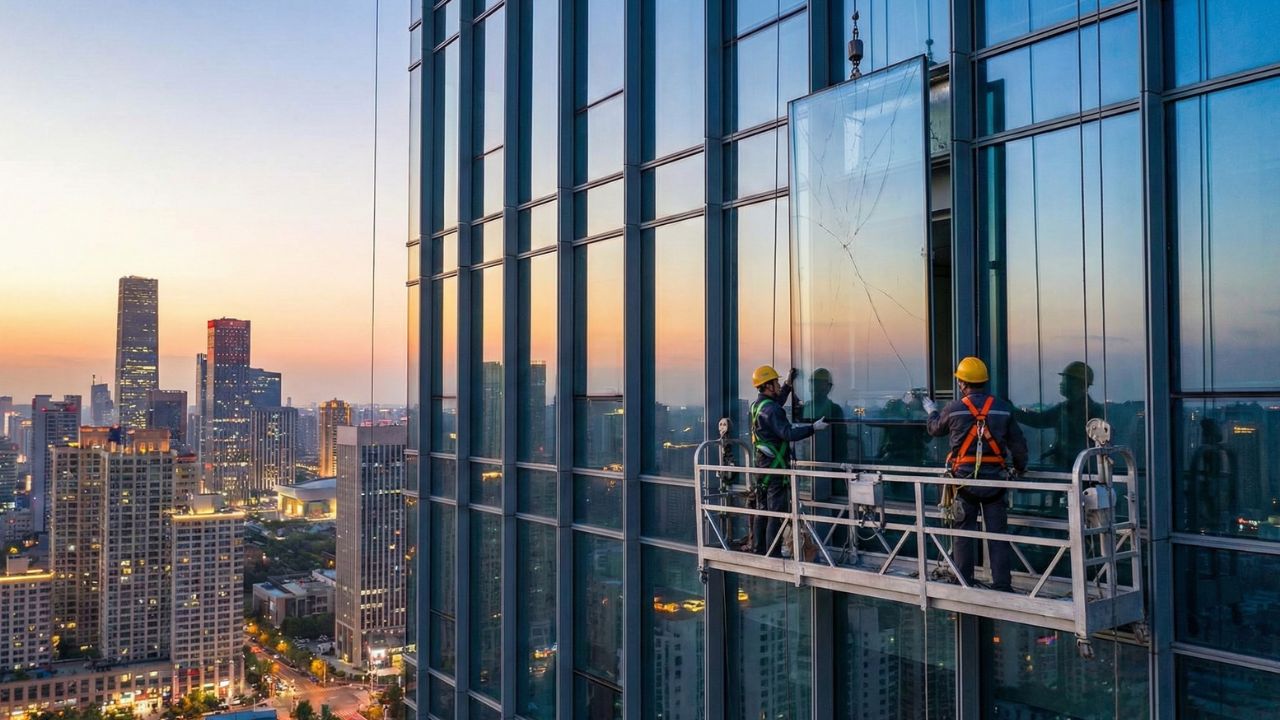
This is the traditional method of facade construction. We install the “sticks” (the vertical aluminum mullions and horizontal transoms) onto the building’s slab, piece by piece. Then, our specialist teams install the glass and panels from the outside, often using cradles or scaffolding.
- Best for: Low-rise buildings, complex geometric entrances, retail podiums, or projects with a highly custom, intricate design.
- The Challenge: It’s slower and highly dependent on the skill of the on-site installers. Achieving a perfect, consistent seal against water and air in a dusty, hot environment is the primary challenge, requiring expert oversight.
Unitized Curtain Walls
This is the modern standard for high-rise facade construction. We custom-engineer and fabricate entire facade panels often 6-8 meters wide and one-floor high-in our controlled factory environment. These complete, sealed, and glazed units are then shipped to the site and simply craned into place.
- Best for: High-rise towers, hotels, fast-track projects, and achieving the absolute highest level of quality, acoustic, and thermal performance.
- The Leskor Experience: We’ve managed projects where a unitized curtain wall system was the only way to meet the client’s aggressive timeline and non-negotiable performance specifications. By moving 80% of the assembly from a chaotic construction site into our factory, we can control the quality of every seal, gasket, and joint. This minimizes on-site variables and delivers a facade that performs exactly as it was engineered to.
Beyond the Glass: The Versatility of Modern Aluminum Facades
While glass curtain walls define our skylines, aluminum facade systems offer incredible design freedom. As a specialist aluminum fabricator, our expertise extends across the full spectrum of these solutions.
- Aluminum Composite Panels (ACPs): The industry has evolved, and so have the materials. We exclusively design and install new-generation, DCD-approved fire-rated ACPs. These panels are lightweight, perfectly flat, and available in any conceivable color or finish (including wood, stone, or corten effects), making them ideal for high-impact branding, soffits, and feature cladding.
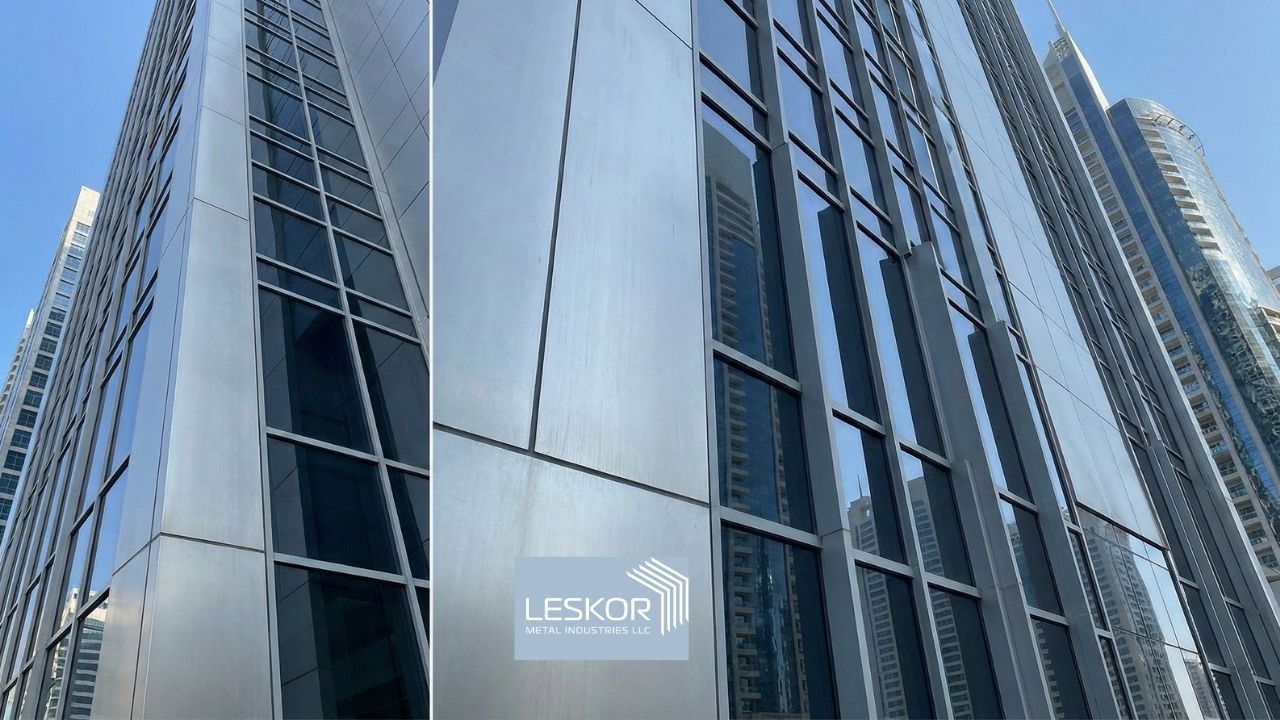
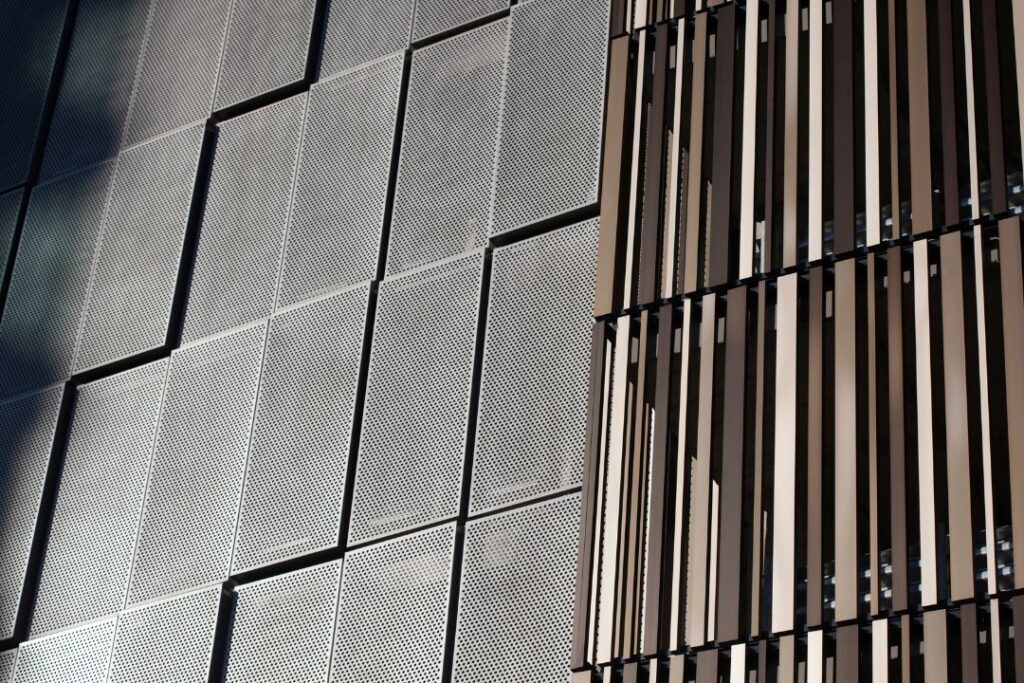
- Solid Aluminum Cladding: For the ultimate in durability and fire safety (A1 non-combustible), solid 3mm or 4mm aluminum panels offer incredible formability. They can be perforated to create intricate mashrabiya patterns for shading, curved to form sweeping building profiles, or angled to achieve truly unique architectural expressions.
- Stick Systems & Window Walls: These are the workhorses for residential towers, villas, and commercial podiums. Our window wall and stick systems are engineered to provide maximum thermal and acoustic performance, giving residents peace and comfort from the city and climate outside.
The Green Rulebook: Building for Al Sa’fat and Estidama
You cannot build in the UAE without mastering the local green building codes. These regulations are not suggestions; they are mandatory gates for your building permits and directly target the performance of your facade construction.
In Dubai: Al Sa’fat
Dubai Municipality’s Al Sa’fat Green Building System is a points-based system (Silver, Golden, Platinum) that is mandatory for all new construction.
Authoritative Source: The Al Sa’fat Practice Guide from Dubai Municipality dedicates entire sections to “Energy Efficiency” and “Resource Effectiveness: Materials.” To get certified, your facade must demonstrate low U-values, use high-performance glazing, and incorporate materials with recycled content. Your facade design is, quite simply, the foundation of your Al Sa’fat score.
In Abu Dhabi: Estidama
Abu Dhabi’s Estidama (“sustainability”) program uses the Pearl Rating System (1 to 5 Pearls).
Authoritative Source: As noted by real estate experts at MyBayut, Estidama is mandatory, and all government-funded buildings (a huge part of the market) must achieve a minimum 2 Pearl rating. This is impossible without a building envelope that is intelligently designed. The “Resourceful Energy” credit is heavily weighted, pushing for passive design strategies, like optimized shading and a well-insulated envelope before even turning on the AC.
Conclusion: Your Façade Partner is Your Project’s Greatest Asset
In the past, the façade was often just an architectural finish. Today, in the UAE, it is a sophisticated, high-tech system that is integral to your project’s safety, legality, and financial viability.
The future of facade construction is already here. We’re engineering facades with integrated LED lighting, dynamic glass that tints with the sun, and “breathing” double-skin façades that manage heat passively.
Your choice of facade contractor is one of the most critical decisions you will make. You are not just hiring an installer; you are hiring an engineering partner. You need a team that has the in-house design and facade engineering capability to collaborate with your architect, the factory-controlled precision to manufacture a system that works, and the on-site experience to install it flawlessly.
At Leskor, this is our specialty. We build the skin that allows your vision to thrive in the desert.