The skylines of Dubai and Abu Dhabi are global icons of architectural ambition. Yet, beneath the gleaming glass and complex geometries of our high-rises lies a critical performance layer that demands absolute precision: fire safety.
For developers, architects, and contractors in the Emirates, facade fire safety regulation is no longer just a checklist item; it is the primary determinant of a project’s viability and longevity. With the UAE implementing some of the world’s most stringent controls following past incidents, understanding the nuances of the UAE Fire and Life Safety Code of Practice is non-negotiable.
At Leskor, we believe that safety and aesthetics must go hand-in-hand. This guide breaks down the essential elements of current facade fire safety regulation, ensuring your project remains compliant, safe, and insurable.
Why Facade Fire Safety Regulation Has Evolved
The UAE Fire and Life Safety Code (enforced by DCD in Dubai and ADCD in Abu Dhabi) is a dynamic framework. It has evolved rapidly from the 2011 edition to the pivotal 2018 update, driven by a need to mitigate the specific risks posed by high-rise density and extreme climate conditions.
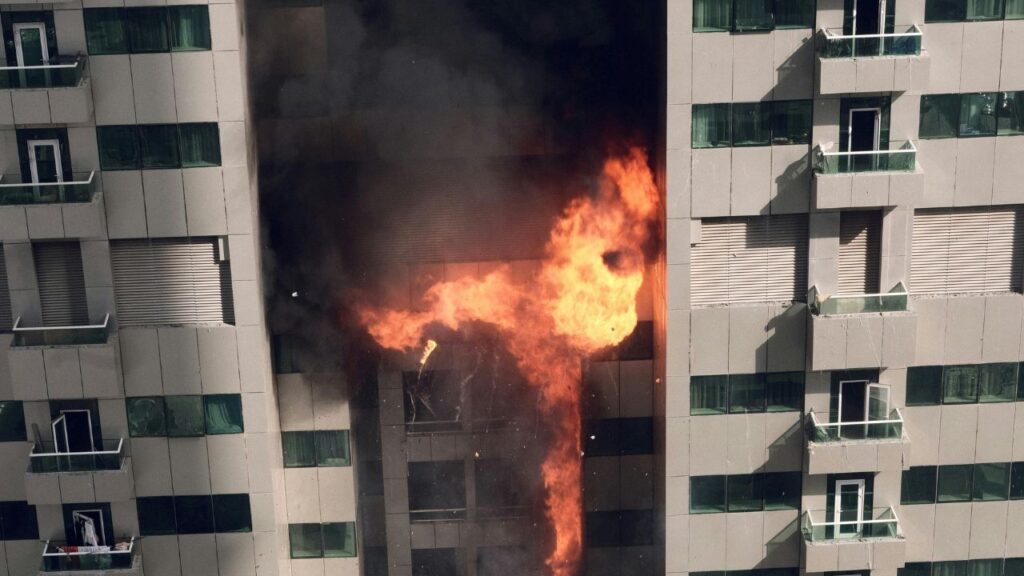
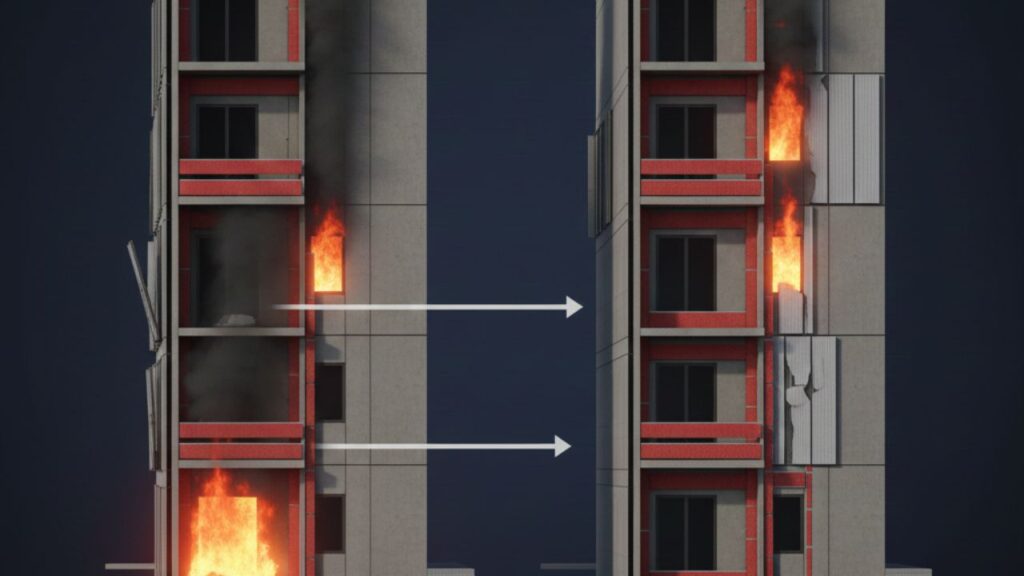
The primary focus of modern facade fire safety regulation is to prevent the “chimney effect”- where a facade allows fire to bypass internal containment measures and spread vertically at rapid speeds.
Key Pillars of Compliance in the UAE
To navigate the current regulatory landscape, industry professionals must focus on four critical areas of the building envelope:
1. System Testing vs. Component Testing
A common misconception is that using “fire-rated” individual materials is sufficient. Current facade fire safety regulation mandates Full-Scale Assembly Testing.
It is not enough for the Aluminum Composite Panel (ACP) or the insulation to be rated individually. The entire system—including the cladding, framing, insulation, sealants, and fixings—must be tested together as a single unit.
- Key Standards: The UAE code heavily references NFPA 285 (standard for evaluation of fire propagation characteristics) and BS 8414.
- The Goal: To prove that the assembly does not allow fire to propagate vertically or laterally.
2. Mandatory Material Classifications
The days of using polyethylene (PE) core panels on high-rises are over. Regulations now strictly enforce the use of:
- A1/A2 Rated Materials: Non-combustible or limited-combustibility cladding materials.
- Approved Insulation: Insulation materials that meet low flame-spread and smoke-development indices.
- Emirates Safety Laboratory (ESL) Certification: Products must carry a Certificate of Conformity (CoC) relevant to UAE standards.
3. Passive Fire Protection: The Hidden Defenders
Perhaps the most technical aspect of facade fire safety regulation involves what happens behind the panels.
- Cavity Fire Barriers: These must be installed at every floor slab level and around openings (windows/doors) to compartmentalize the facade cavity.
- Perimeter Firestops: These seal the gap between the edge of the floor slab and the back of the facade cladding, preventing smoke and flames from leaping from one floor to the next.
4. Spandrel Separation Requirements
For buildings exceeding 15 meters, specific spandrel separation is required. This involves creating a vertical or horizontal distance between the vision glass of consecutive floors to act as a physical fire break.
The Approval Process: From Design to Inspection
Compliance with facade fire safety regulation is a continuous process, not a one-time stamp.
- Design Review: A DCD/ADCD-approved “House of Expertise” (Fire Consultant) must review and endorse the facade design before any material is ordered.
- Installation by Licensed Parties: Facade installation must be carried out by Civil Defence-registered installers who are certified by the system manufacturer.
- Field Inspections: The code mandates rigorous on-site inspections (often at 20% intervals) to verify the installation of hidden elements like fire barriers. Destructive testing may be required to prove installation quality.
How Leskor Ensures Compliance
Navigating the complexities of facade fire safety regulation requires more than just reading the code; it requires engineering precision.
As an integrated facade specialist, Leskor bridges the gap between architectural vision and regulatory rigidity. We ensure:
- Engineering: Our designs are optimized to pass NFPA 285 standards while maintaining aesthetic integrity.
- Material Sourcing: We utilize only DCD/ADCD-approved materials with valid CoCs.
- Execution: Our installation teams are trained in the precise application of fire barriers and stopping systems, ensuring that the “as-built” facade performs exactly as the “as-designed” system.
Ignorance of regulations is a liability. Expertise is your best insurance.